

Time To Check-in: Holding Space in a Heavy World
A gentle year-end check-in exploring how to hold space for hope and grief, rest and responsibility, and the quiet need for compassion—in ourselves and in the world around us.

December arrives each year with familiar expectations — closure, celebration, gratitude, and fresh starts waiting just beyond the calendar - but December also arrives carrying weight.
Across the world, people are holding more than they can easily name. Grief sits alongside hope, fatigue coexists with faith, joy and sorrow share the same rooms. For some, the season brings rest and gathering. For others, it heightens loneliness, uncertainty, or the quiet ache of displacement — physical, emotional, or spiritual.
We may be stating the obvious — but when someone is in the heat of a difficult season, it is often the obvious truths that are hardest to hold onto. Pain has a way of narrowing our vision. Overwhelm can make it feel as though one emotion must cancel out another, when in reality, life rarely works that way.
This season quietly reminds us of something both simple and profound: two opposing realities can exist at the same time. Joy does not erase grief. Grief does not negate gratitude. The same person can be holding celebration and sorrow in the same breath — welcoming new life while mourning loss. These emotional overlaps are not contradictions; they are evidence of being fully human.
Such emotions are not always easy to unpack, and they don’t ask to be resolved quickly. In moments like these, grieving — in all its forms — is often the kindest thing we can do for ourselves. Not fixing. Not explaining. Simply allowing what is present to be acknowledged and honoured.
So this is a check-in.
And also an extended hand.
For anyone who needs a safe space to rest a little, to pause without having to perform strength or clarity — you are not alone.
This is where space matters.
The spaces we inhabit — our homes, workplaces, places of rest, reflection, or worship — shape how safe we feel to breathe, to release, to be honest. A well-held space can regulate the nervous system without words. A poorly held one can quietly amplify stress, exclusion, or disconnection.
The same is true internally.
A year-end check-in asks different questions:
- Where am I holding tension without realising it?
- Where does my environment support me — and where does it exhaust me?
- What do I need more of right now: silence, connection, rest, meaning?
December also carries spiritual significance for many — a season of light, remembrance, and hope. Across traditions, there is a shared understanding that something sacred happens when we pause.
This is not the month to fix the world.
But it is a month to hold it — with compassion, awareness, and care.
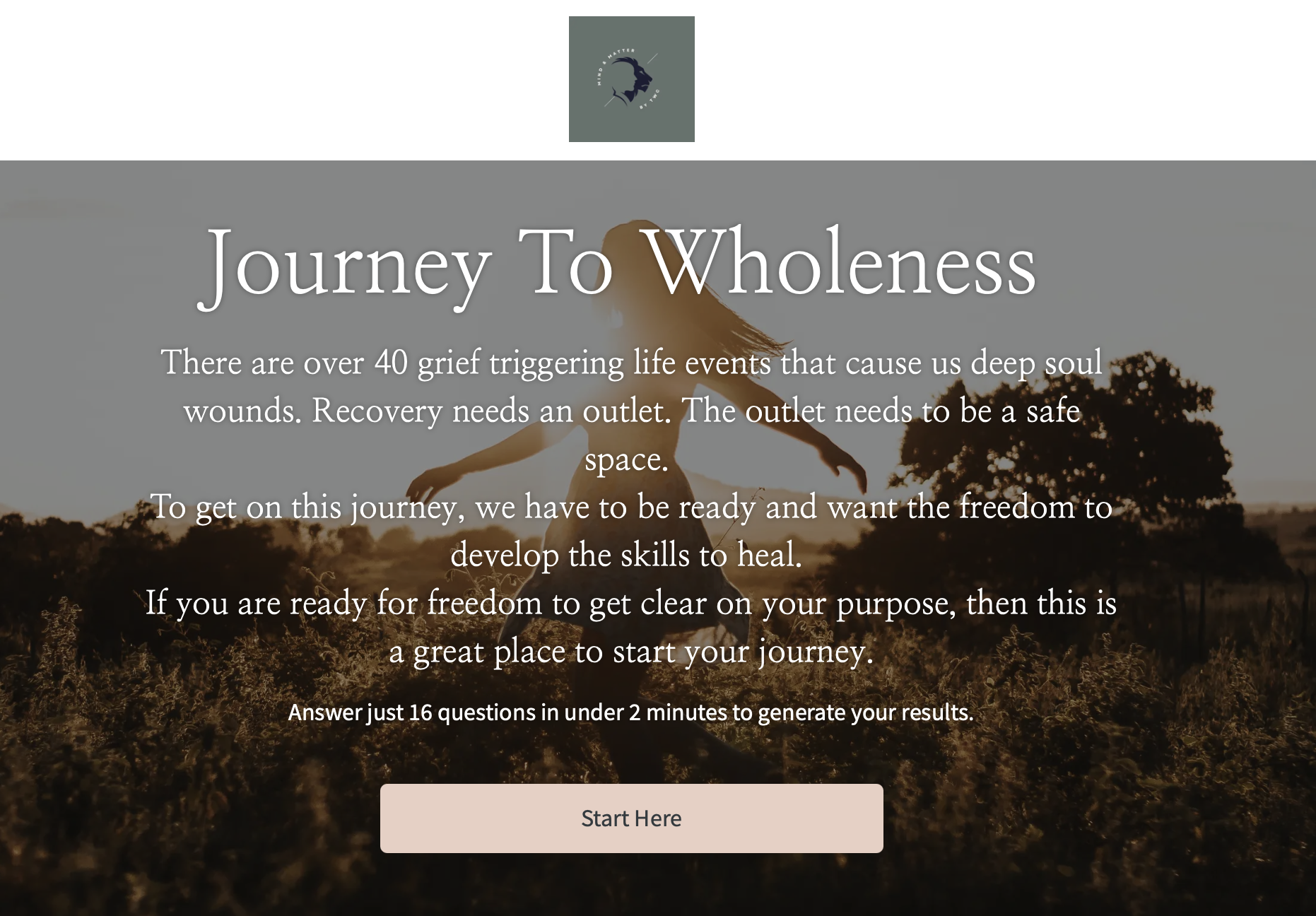
If you would like help identifying where you are right now — emotionally, mentally, physically — you are invited to take the Journey to Wholeness check-in. It is not a test or diagnosis, but a reflective starting point to help you notice what you may need next and begin shaping a gentle blueprint toward wholeness.
Begin here: with this Wholeness scorecard.
A gentle note:
The Journey to Wellness check-in is a reflective tool designed to support self-awareness and clarity. It is not a diagnostic assessment or a substitute for medical, psychological, or therapeutic care. If you are experiencing distress or need immediate support, please seek help from a qualified professional or trusted service.
Thank you for engaging with us this year 2025 and we hope it has been beneficial to you.
As the year turns, may your spaces hold you well.
May your pace be humane.
May you enter the next season grounded in presence rather than pressure.
And may The Prince of Peace be your Anchor in the season.
Merry Christmas…

The Unrushed Reset
Week 1: From Here to There
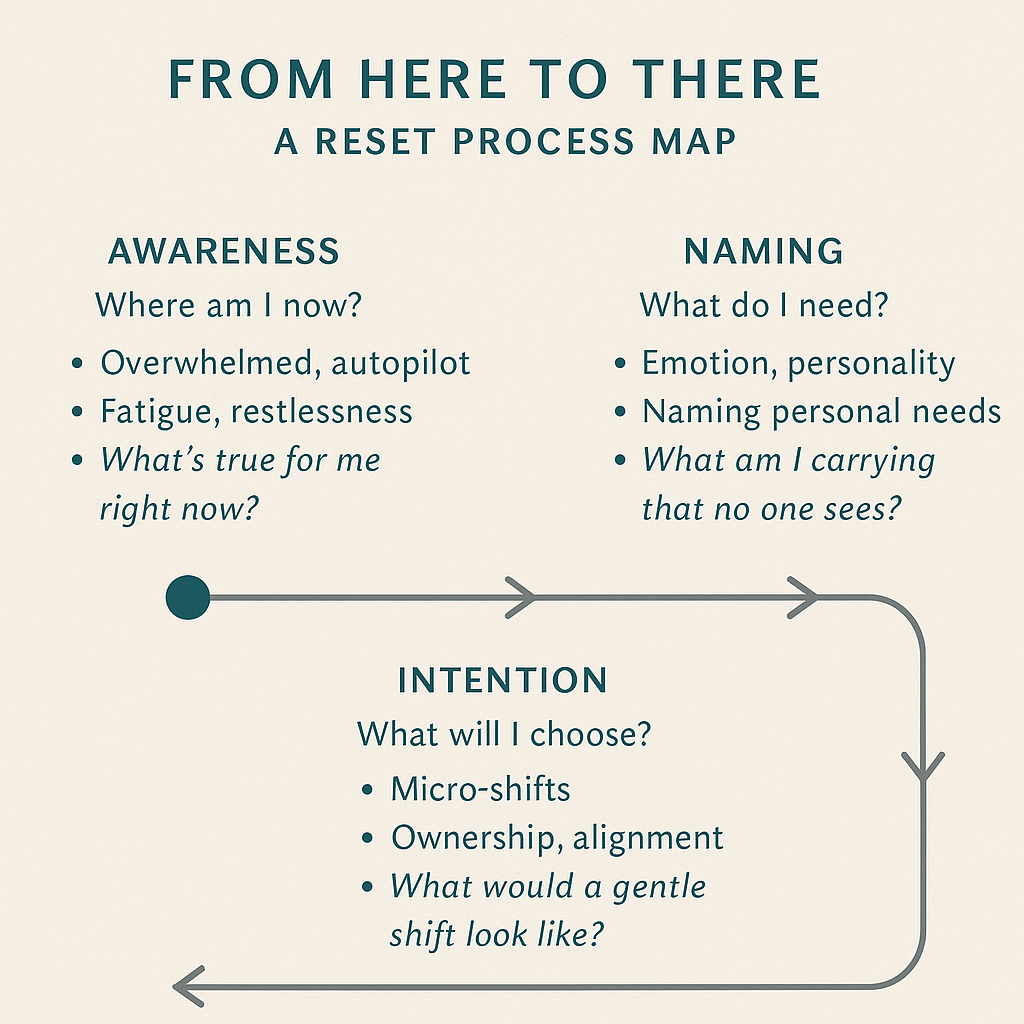
A gentle guide to self-awareness and intention, making space for clarity, compassion and creative flow.
Introduction
We’re not all starting from the same place — and we’re certainly not wired the same way. That’s why one-size-fits-all wellness advice often falls flat.
Some of us are silently burning out behind our smiles. Others are juggling so many roles, we forget who we are when things go quiet. That’s why this week, we’re slowing things down and getting honest about where we are — without shame, without rush.
This week’s reset invites you to see yourself clearly and kindly. To reflect. To choose practices that suit you — your pace, your personality, your life load.

How are you anchored?
This isn’t about fixing. It’s about noticing. Where you are. What you need. And where you feel called to go.
🧭 Reset Pathways by Personality
We’ve painted four real-life-inspired portraits below — each one rooted in different ways of being, different rhythms of life. You might see yourself in one of them. Or in the spaces between.
1. Leah – The Quiet Processor (Introvert)
Leah thrives in solitude but struggles to make room for it. Meetings, notifications, and expectations crowd her schedule — until her thoughts feel tangled.
She’s learning to protect silence like a sabbath. One walk a day. No phone. Just breath and trees.

Leah’s Reset Practice
Mindset: “Quiet is not laziness. It’s clarity.”
Self-Care: Schedule silence — even 15 mins counts.
Emotion Tool: Stream-of-consciousness journaling (no edits).
Creative Spark: Gather textures (stone, fabric, wood) that bring calm and place them somewhere visible.
2. Dayo – The Expressive Connector (Extrovert)
Dayo draws energy from people — but lately, even the joy of connection feels exhausting. He’s always “on,” rarely pausing to check in with himself.
He’s trying something new: voice notes to himself. A check-in before checking on others.
Dayo’s Reset Practice
Mindset: “I can’t pour deeply if I never refill.”
Self-Care: One unplugged evening with a no-obligation friend.
Emotion Tool: Self-reflection voice notes.
Creative Spark: Write a short letter to your future self 30 days from now.
3. Malika – The Flexible Anchor (Ambivert)
Malika moves easily between people and peace — but as life demands pile up, she feels stretched thin. Always the helper. Rarely helped.
She’s learning to say yes to herself first. Even if it’s just one thing a day.
Malika’s Reset Practice
Mindset: “My needs are not an inconvenience.”
Self-Care: One daily “yes” to herself — big or small.
Emotion Tool: Traffic light check-ins (Red = depleted, Amber = unsure, Green = good).
Creative Spark: Create a “Do Less” list and celebrate sticking to it.
4. Tomi – The Brave Tending of a Single Primary Parent Over 45
Tomi’s day starts before the alarm. Shoes to find, cereal to pour, school bags to check — all while juggling work emails. By 8:30 a.m., they’ve made 15 decisions and barely taken a breath.
Lately, Tomi’s begun using post-it notes as small anchors.
On the fridge: I feel scattered. I need five minutes outside.
By the kettle: I feel worn. I need something warm.
One morning, Tomi’s daughter adds her own: I feel fine. I need a snack. They laugh. It becomes a family rhythm.
Little visual reminders that everyone — including caregivers — has needs.
Tomi’s Reset Practice
Mindset: “What would it look like to offer myself the same grace I give others?”
Self-Care: Mirror moments — speak one kind truth to yourself daily.
Emotion Tool: “Name + Need” post-it check-ins.
Creative Spark: Create a family or solo drawing/list of a peaceful day — and bring one part of it to life this week.
Closing Reflection
These aren’t prescriptions — they’re invitations.
You may find yourself in Leah, Dayo, Malika, or Tomi — or somewhere entirely your own.
This week, choose to pause — just enough to ask:
What’s true for me right now?
What am I carrying that no one sees?
What would a gentle shift look like?
Reset isn’t about becoming someone new.
It’s about returning — to your truth, your needs, and your next best rhythm.
Until next week, be kind to yourself.
USI